Quantum physicist
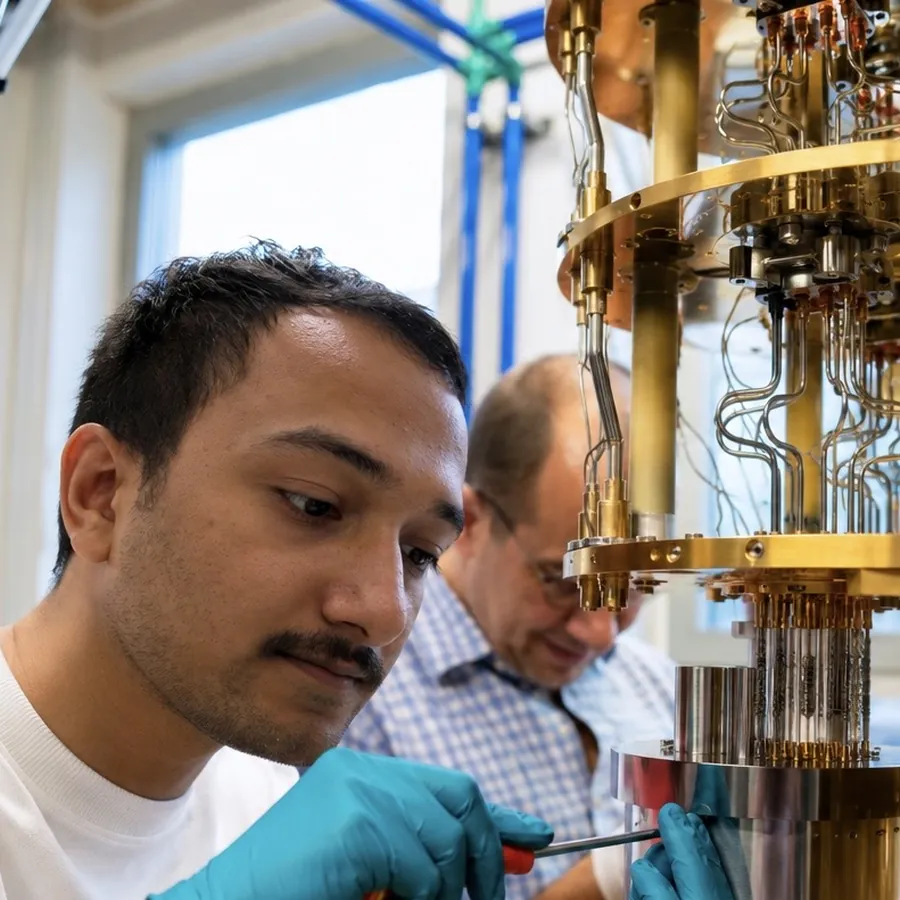
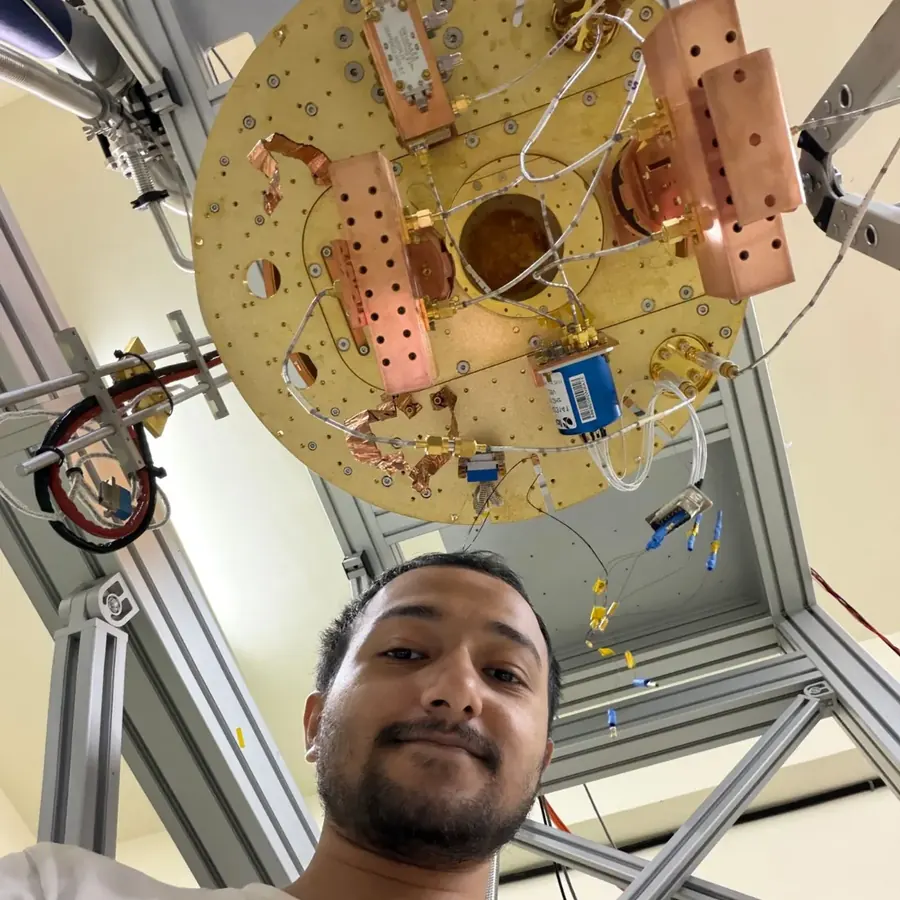
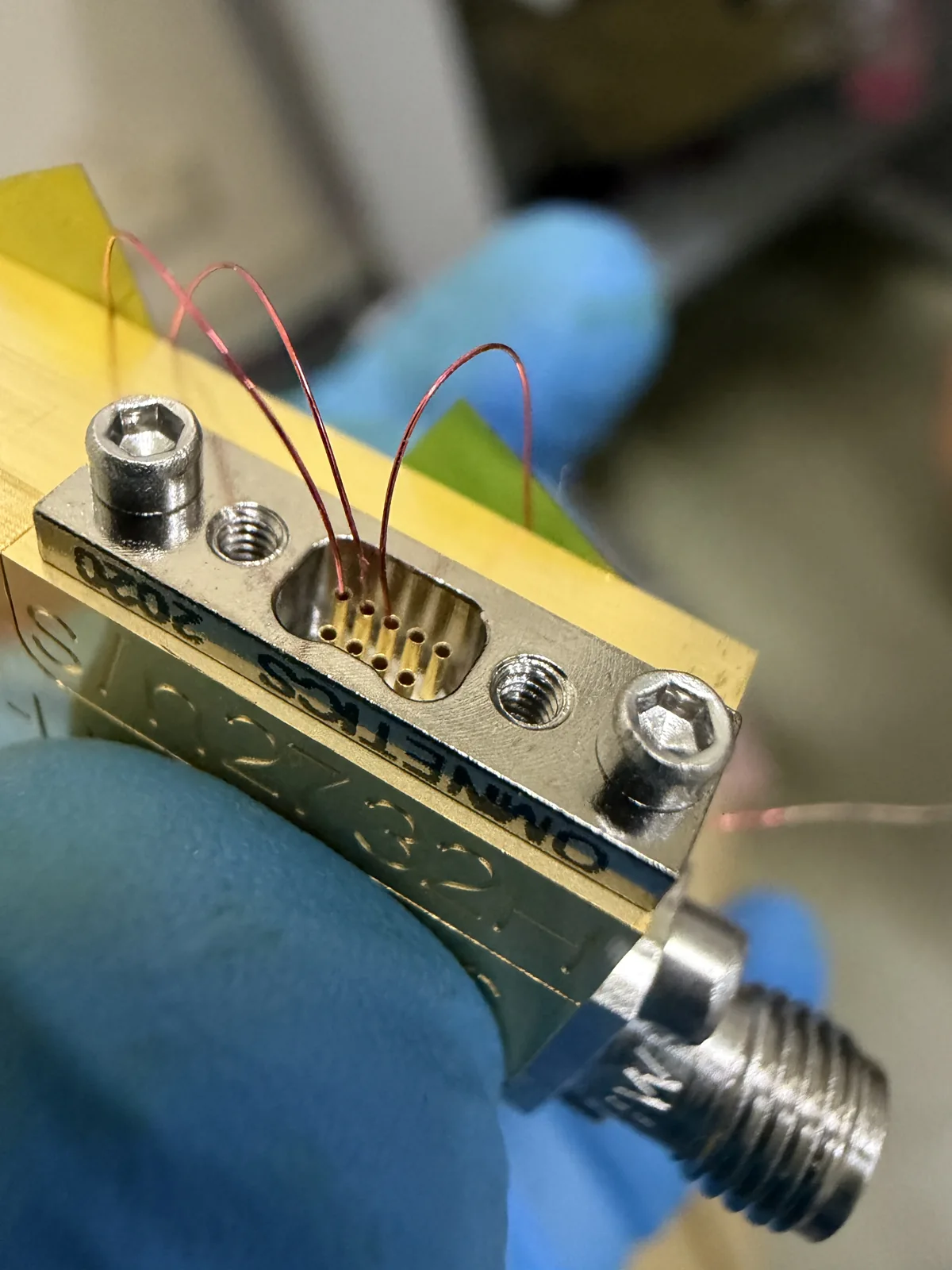
At the Quantum Circuit Lab in Taiwan, I cool superconducting circuits and use microwaves to measure them. On paper, I study a different question. Why do some quantum waves spread while others crowd against a boundary?
What does a qubit tell us?
My experimental work is at the Quantum Circuit Lab in the Department of Physics at National Sun Yat-sen University, Taiwan. My advisor is Assoc. Prof. Kuei-Lin Chiu.
A qubit has a characteristic transition frequency. By sweeping a microwave tone and looking for a change in the readout, I can locate that transition. The next question is how long an excitation survives after the drive stops.
Can a wave lean against a wall?
Imagine 17 sites in a row. A particle can hop to either neighbour. The bars below show how one wave is distributed along the chain. Give the two directions different hopping strengths and see where the weight goes.
This is a textbook model with open ends. My sole-authored preprint asks what changes when the chain has alternating bonds and a second pattern that tends to pin the wave in place. In part of the phase diagram, an intermediate modulation lets states spread out again.
Explore the larger model at Vishwa Vigyan Labs →
If you’re studying this for the first time, try explaining what changed when you reversed the bias. Write to me about the part that surprised you.
When training looks stable
The mathematics behind directed hopping has a second life in machine learning. A small disturbance can grow for several steps even when the usual long-term stability check looks reassuring.
In my preprint on neural-network training , I use small two-layer networks to test a quantity that tracks this temporary growth. It separated stable and unstable cases in those experiments.
My other line of theory looks at electron transport through tiny conductors, including what measurements can tell us about where charge accumulates.
Vishwa Vigyan Labs
My independent work has its own home at Vishwa Vigyan. The project pages include models you can try and distinguish published work from open questions.
- Non-Hermitian systems — why a wave can gather at the edge of a chain.
- Quantum Time Lab — an ongoing study of transport and the interpretation of time.
- Big Bang Atlas — an early exploration of cosmology with Prof. Prosenjit Singha Deo.
- Quantum AI — experiments and an interactive illustration of a driven qubit.
Papers
-
Negative Local Partial Density of States
Kanchan Meena, Souvik Ghosh & P. S. Deo
Journal of Condensed Matter · 3(1), 16–21 · DOI 10.61343/jcm.v3i01.113
-
Non-normal spectral signatures of instability in neural network training dynamics
Souvik Ghosh
arXiv:2605.23476
-
Competing skin effect and quasiperiodic localization in the non-Hermitian Su-Schrieffer-Heeger chain: Reentrant delocalization, spectral topology destruction, and entanglement suppression
Souvik Ghosh
arXiv:2603.20330
-
Reinterpreting Landauer conductance, solving the quantum measurement problem, grand unification
Kanchan Meena, Souvik Ghosh & P. Singha Deo
arXiv:2512.09709
-
Exploring Topological and Localization Phenomena in SSH Chains under Generalized AAH Modulation
Souvik Ghosh & Sayak Roy
arXiv:2506.10195
Related writing and work in progress
-
“We May Have Built the First Step Toward Real Time Travel — And It’s Already Peer-Reviewed”
Souvik Ghosh · 6 May 2025
Medium. An introduction to the authors’ interpretation of their research; the papers and books are the technical record.
-
Non-Hermitian Skin Effect as a Quantum Battery Resource: Passive Ergotropy and Protocol-Dependent Charging in the SSH Chain
Souvik Ghosh, Sayak Roy, Saurabh Mishra & Nituparna Das
In development
Research background
I completed my M.Sc. in Physics at Adamas University in 2024, specializing in condensed matter. My dissertation studied how a quasiperiodic layer changes reflection at a junction between a metal and a superconductor.
My earlier research at the S. N. Bose National Centre for Basic Sciences in Kolkata focused on mesoscopic transport.
For research enquiries, write to souvikghosh2012@gmail.com .